Category: Long Distance Trails
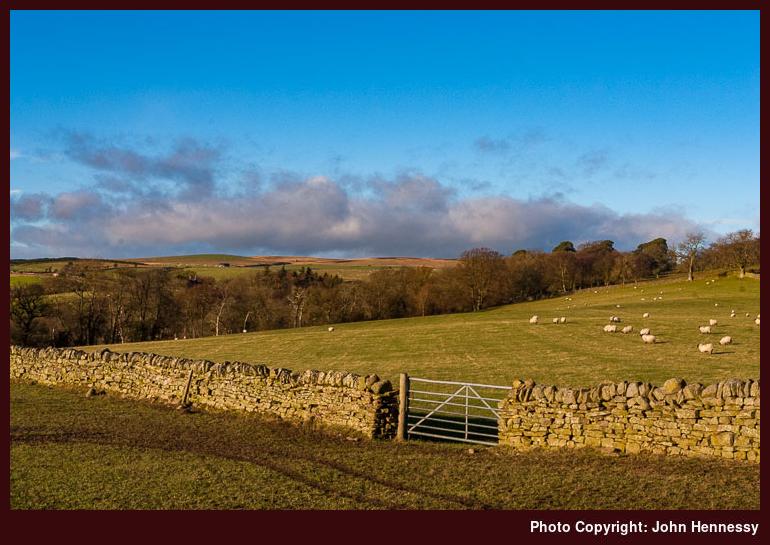
Rob Roy Way: a tempting proposition?
 23rd February 2007
 On one occasion when I was out walking during my stay in Highland Perthshire last summer, some people that I encountered asked me if I was doing the Rob Roy Way. I think that they were disappointed when I said that I wasn't. At the time, I had been walking from Kenmore and was nearing Aberfeldy, my final destination for the day and where I was catching a bus back to Pitlochry, the base for my visit. That meant that I was in a rush at the time, but I did manage to make time to stop and share a few words with them. Nevertheless, I still had five minutes to spare when I reached the bus stop, not bad going.
Recently, in preparation for my most recent stroll on the West Highland Way, I bought a new OS Explorer 348; I know that the WHW is well waymarked, but it's better to know your exact position at all times. And a map is good for telling you what's around you as well. However, on the top left-hand corner of the map, there was another green-dotted line: that of the Rob Roy Way. A spot of further investigation has revealed it to be a trail starting at Drymen and heading across the Trossachs on its way to Pitlochry. Along its length, it passes places such as Aberfoyle, Callander, Strathyre, Lochearnhead, Killin, Kenmore, Amulree and Aberfeldy. Between Killin and Aberfeldy, there is a choice of routes: one going around by Amulree and a shorter, more direct course. The latter is described in the Rucksack Readers guide to the long distance path, while the former is only described on its official website, a truly useful calling point for planning a trek on the RRW.
The trail has only been in existence since 2002, making it a mere youngster in comparison with the 27-year-old West Highland Way. In fact, unlike like other trails, it has yet to be waymarked. That, and the fact that that mapping, presented in my OS Explorer 379, dates from 2001, explains how I had been straying along the way between Tombuie cottage and Aberfeldy without realising it. And it hasn't been the only section that I have encountered, either. In 2002, I followed part of the RRW when I went for a walk up the slopes of Ben Ledi by way of the section between Callander and Strathyre, though it may be that this ramble pre-dated the RRW. Moving away from this somewhat accidental approach seems an appealing proposition. The key attractions of the RRW for me are its passage through the Trossachs and skirting of Loch Tay. So far, my walking in these areas has been limited and the RRW would take that forward a great deal and there is definitely much to commend the area.
Postscript: Rucksack Readers
While I mentioned Rucksack Readers above, I thought that I'd say a bit more about them. They offer a range of guidebooks covering trails in Scotland, Ireland and beyond. The idea is that you carry them in your rucksack while out on the trail. Consequently, they are waterproof and lightweight. Added bonuses are the inclusion of mapping and the ability to fold the guidebooks flat. Their Irish range includes: Dingle Way, Kerry Way and Wicklow Way. Apart from maybe the Dingle Way, I had heard of these and the guides are a welcome addition to the market. But it was the Scottish range that alerted me to some trails about which I had known nothing: Cateran Trail and Kintyre Way. Otherwise, stalwarts such as the West Highland Way and Great Glen Way are covered, as are the Rob Roy Way and the Speyside Way. Going further afield, treks in Europe, Asia and South America get are featured.
West Highland Way revisited
22nd February 2007 Last weekend, I pottered up to Scotland to take in the scenery lining the southernmost section of the West Highland Way. Having followed the esteemed long-distance path all the way from Bridge of Orchy to Fort William, albeit in a piecemeal manner, I have decided to see if I can have a go at completing it. And yes, the piecemeal approach continues.
Before I describe my latest trek, I'll let you in on my previous exploits. My first real outing on the WHW, apart from being in its vicinity when I was starting to explore Glen Nevis near Fort William, was when I walked the section from Kinlochleven to Glen Coe on a largely cloudy day that tried to brighten up at one point. The second encounter was on another cloudy day but one without any sun; that was when I headed from Kinlochleven to Fort William. The scenery was so outstanding that I returned on a sunny weekend to repeat the walk, and I was not to be disappointed. Following that, I explored the section between Glen Coe and Bridge of Orchy. That day had a lot of cloud about, but the sun made its way through for a good part of the journey.
And now to my most recent excursion. An overnight National Express coach service got me to Glasgow from where I headed to Milngavie (pronounced mullguy), the southern terminus of the WHW, after getting myself some breakfast at Buchanan Bus Station. Once in Milngavie, I picked up the WHW and followed it through the path-strewn Mugdock Wood on a very crisp morning with frost abounding everywhere, a very memorable experience.
Eventually, my journey took me past both Craigallian Loch and Carbeth Loch and on towards the gloriously appealing Campsie Fells. The outlying knob of Dumgoyne, one of their number, very much played the role of a distinctive landmark for much of my walk and looked much grander than its 428 metres height would suggest. A farmer putting out hay for his cattle and their procession along the WHW track distracted attention for a while, but it was the surrounding scenery that was the real attraction.
Surprisingly for a trail that courts a lot of fine scenery, the WHW keeps out of the Campsie Fells and follows a disused railway, the old Strath Blane Line, from Dumgoyach Farm until it ventures onto a minor road as it nears Drymen before heading off-road again for Balmaha and beyond. I suppose that the one issue is that there is no old right of way through the Campsie Fells that passes near Strath Blane. Naturally, there is also the issue of distance and the effect on a walker of continual ascent and descent in hilly country, but these are considerations for the walker. Given that Conic Hill near Balmaha is a no-go area during the lambing season, another concern would be the potential effect on sheep during the lambing season. While Scotland's current access legislation could allow things to happen in principle, I see a re-routing of the West Highland Way as being highly unlikely. Nevertheless, the thoughts of proceeding through the Campsie Fells are far more appealing than the reality of shadowing busy roads while walking on a disused railway line, even if this route possibility would require some road walking through Killearn to the old railway line for the rest of the walk.
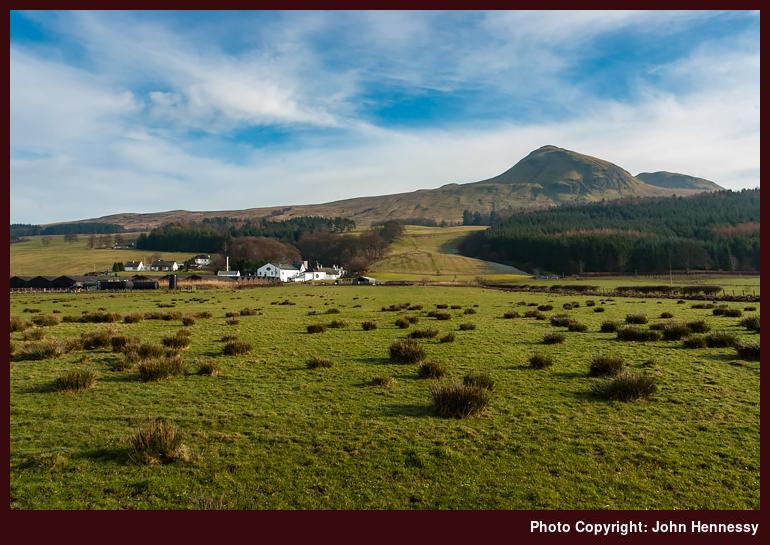
I was a tired walker when I reached Drymen in pleasant sunshine, but the cloud had rolled in by the time that I got to Balloch by bus; it was from there that I eventually headed home. In fact, there was a good deal of cloud about that day, and at times it blocked the sun and put a dampener on photographic exploits. Another fly in the ointment was the more than ample number of pylons that dotted (and in my view blighted) the landscape in a number of places. Also creating compositional challenges was the quarry that got in the way when I was trying to enjoy the enchanting views of the hills across Loch Lomond while on the final approach to Drymen. Actually, taking a spot of care meant that things didn't look too bad in the foreground of the photographs taken. Then there was the matter of ensuring that Loch Lomond's surface was not at an angle; it's very easy for those horizons to develop a slant...
All in all, the day was enjoyable, and I am planning to plug the gap between Drymen and Bridge of Orchy. A weekend visit could allow me to cover the WHW between Drymen and Inverarnan, with a break in Rowardennan. And a long day could get me from Inverarnan to Bridge of Orchy, although a break in Crianlarich might make things more comfortable. Plans are one thing, let's see how the reality turns out.
Another Pennine day
5th February 2007 The sunny weekend tempted me into the outdoors after something of a hiatus; January did not offer much in terms of dry sunny hillwalking weather at the weekends though I did get out around Chirk and Llangollen on what was a fine mild Sunday in the middle of the month. In fact, only for the fact that I had a driving lesson on last Saturday (it has finally happened after talking about it for what seems an eternity), I might have gone off for the whole weekend but I really have to get that skill under my belt.
Therefore, with Saturday sadly out of the picture (it was a smashing day for learning to drive, even if the sun caused some glare), I needed to decide what to do on Sunday. Thankfully, the crisp fine weather stayed with us and I headed off into the South Pennines for a day in the hills. After a bus ride into Manchester, I took the Metrolink to Victoria station, from where I caught a train to Hebden Bridge. From there, I picked up the Pennine Bridleway and that took me on to Stoodley Pike and the Pennine Way. Once on the Pennine Way, I continued south until I met another section of the Pennine Bridleway that took towards Littleborough and Smithy Bridge. By some strange navigation (it was dusk at the time, after all), I managed to get to Smithy Bridge train station rather than the one in Littleborough. That gave me a few more minutes than I would otherwise have had, a very welcome commodity when making a train after a long walk. Nevertheless, brushing up on my low light navigation skills is required.
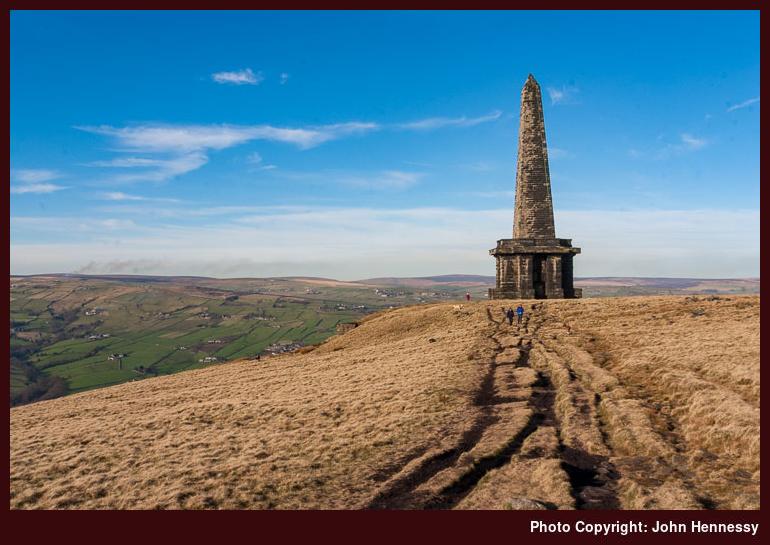
And what of the walking itself? The day was one spent in a wild, somewhat industrialised, moorland criss-crossed by a plethora of bridleways and footpaths in pleasant sunshine. Good paths ensured that heavy going was not encountered for as long as it otherwise have been. That allowed steady progress without recourse to the opportunities for route shortening allowed by the populous Calderdale (or is Caldervale?) valley, a consequence of the area's industrial past. The Stoodley Pike Monument, a memorial to the Napoleonic wars, dominated the skyline for a lot of the walk and provided a useful focal point for my photographic efforts. After that, it was onto walking around reservoirs on the approach to the White House pub. Once across the road, I picked up an old Roman road forming part of the Rochdale Way. Cobbles are visible today, though I am unsure of their antiquity. That path led me to another part of the Pennine Bridleway before I continued towards a golf clubhouse, where confusing navigation got me worried for a while, before the reassuring sight of another reservoir told me that I was on the right track.
In summary, I got to walk another part of the Pennine Way. Heading from Littleborough to Marsden along another section of it is a very tempting proposition for a Sunday stroll. And so is heading north from Hebden Bridge but I will need to see where that might take me so that I can make it another day walk. It looks as if my Pennine Way explorations are continuing.
A trip to the North Wales Borderlands
16th January 2007 I was over in Llangollen last Sunday and picked up a copy of the 2007 visitor brochure for the North Wales Borderlands. Under this banner, the local authorities of Wrexham, Flintshire and Denbighshire are promoting the area's worth as a destination for visitors; particularly those who might stay for a few days, I would assume. The area may not be foremost to those considering North Wales for a holiday, but the area definitely does have its charms and does prove to be something of a visitor magnet in its own right.
My first encounter with the region was when I began to visit Llangollen. The town might list a heritage railway and canal among its attractions, but it is its location in the scenic Vale of Llangollen that draws me. To the south of the Dee Valley lie the wilder country among the Berwyns and the Offa's Dyke Path, a national trail, also passes near here. On my first foray, I walked over the hill playing host to the ruins of Castell Dinas Bran before heading to another ruin, that of the splendid Valle Crucis Abbey. From there, my return to Llangollen took me by the Llangollen Canal and within sight of the Llangollen Railway. Other visits have seen me taking in the Horseshoe Falls and sections of the Offa's Dyke Path. One trek along this national trail saw me walk from Llangollen to Llandegla before heading to Wrexham and returning home.
The Vale of Llangollen hasn't been the only part of Denbighshire that has been the subject of my attentions, though. In fact, I once headed to Denbigh in the Vale of Clwyd for a low-level walk along the line of the Clwydian Range to Ruthin (or Rhuthun in Welsh). That was sufficiently enjoyable that a return to those parts remains a possibility.
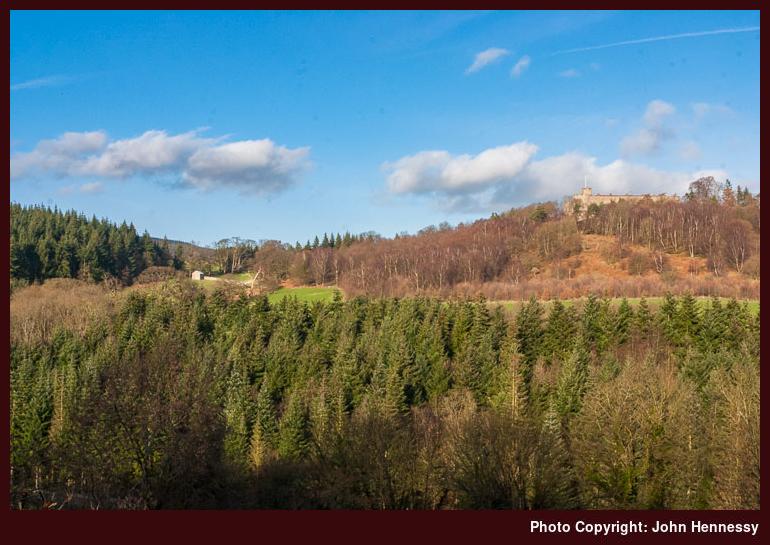
To return to last Sunday, the offer of a fine day in Wales was too tempting to ignore, and it felt more like April than January. Initially, my plans were to go to Llangollen for a walk in the vicinity of the Berwyns, but an alternative idea came to me and replaced the original one. The new scheme took me to Chirk, from where I picked up a short section of the Offa's Dyke Path after proceeding along the Ceiriog Valley, rounding the substantial hulk of Chirk Castle on my way. I then left the trail to head for Llangollen and was greeted by fine views of the Vale of Llangollen on my descent to my destination. The only fly in the ointment was the lack of height in the sun late on a January day, but the vistas were memorable nonetheless.
Return to Northumberland: around Bellingham
15th December 2006 Last Saturday, I took my chance after all the naff weather that we have been having and headed off to the hills when the opportunity presented itself. Northumberland offered the chance of a dry day when showers were afflicting other parts. The railway got me to Hexham and back again, with changes at Manchester and Carlisle along the way. Hexham, with its centrally located abbey, was a tempting proposition, but my plans meant that it had to be left for another day. From Hexham, I took the useful Tyne Valley Coaches 880 to and from Bellingham. Plus Bus ticketing would have covered both rail and road transport but for the fact that I did not realise it: something for the future then.
While there, I took a stroll along a short section of the Pennine Way out as far as Hareshaw House before returning on another public footpath. The ramble took me into and out of the Northumberland National Park, which excludes Bellingham for some reason. Unsurprisingly given the weather that we have been having recently, muddy stretches abounded, and extra care was needed when going through any gates: I still retain the memory of having mud up to my left shin after a careless step while following the Dane Valley Way as part of a walk from the Cat and Fiddle Inn in Cheshire to Rushton Spencer in Staffordshire around this time of year in 2004. On my way back to Bellingham, I followed what clearly was an alignment of some sort, almost like the bed of a railway track and raised in places. However, its bridges over streams have not survived, so some diversions proved necessary; I still returned to Bellingham with an hour to spare, time that allowed me to savour some walks along the North Tyne (which joins with the South Tyne to give, you've guessed it, the same River Tyne that flows through Newcastle-upon-Tyne: they don't seem to expend much energy naming rivers up here) before the light faded completely.
I only got to savour but a small sample of the countryside that surrounds Bellingham, so there is further potential for walking trips. And I think that I need to find out more about the area as well...