Category: Europe
A new GPS receiver
 18th June 2016
 Most if not all articles written about outdoors gear usually do not contain any mention of life circumstances, yet they pervade this one. To me, January 2015 brought a life-changing event whose alterations still are ongoing. My father's passing away last year and that of my mother years nearly two years before then now make for a very changed set of circumstances. Not having to deal with my father's fear of flying has meant that I can countenance overseas excursions like those that took me to Iceland and Switzerland last year, together with Austria a few weeks ago.
Motivation & Opportunity
If it were not for last year's trip to Iceland, I may never have acquired a GPS receiver. Apart from an abortive attempt to buy a Magellan eXplorist 100, it stubbornly remained on the nice-to-have section of any gear wish list since I never got to spend the outlay. It was exposure to the shortcomings of maps with a 1:100000 (1 cm per 1 km) scale on a walk around Landmannalaugar that finally convinced me to try again. Even with a subsequent trip to Switzerland and perhaps because of what I spent on accommodation, travel and other things, the acquisition that had to wait.
The deed itself was done in circumstances that one might have expected to produce a different set of priorities, for it was in the time around last Christmas. My plan was to spend Christmas itself in Britain before heading to Ireland for a few days and returning before New Year's Day. That didn't happen, as emotions just were too raw, and I rearranged the trip for sometime in January. One thing that added to my melancholy was how things went during Christmas 2014 when a neighbour of my parents went about planning Christmas 2015 when all I wanted to do was get into 2015 and leave 2014 after me. Now Christmas has lost all its child-like allure for me, I tend to want to get past it rather than bringing the next one closer.
Not travelling to Ireland at the end of 2015 meant that I could get past last Christmas and leave it after me to grow smaller in the rearview mirror of life. Doing otherwise would mean lugging too much emotional baggage through 2016 and that was why that 2014 invitation hurt me as much as it did; that Christmas was one that I needed to leave after me. The extra time at home was put to good use too, for I embarked on a tidying spree that resulted in so many bin bags of items for disposal and recycling that it took a few weeks to clear them. Aside from the last Tuesday of the year or the afternoon of Christmas Eve, the weather had not been so enticing anyway, and it felt like a pathetic fallacy that so much rain fell and the winter generally was a rain-drenched season anyway.
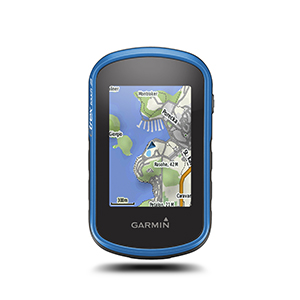
Having bailed out of the planned Irish trip on St. Stephen's Day, or Boxing Day as it is known in the U.K., I decided to book the purchase of the long-windedly titled Garmin eTrex Touch 25 from Go Outdoors' Manchester branch. Perusal of a newspaper on the way there revealed just how miserable some people's Christmas had been, for they were physically flooded while I was emotionally so; the Calder valley had been very badly hit by the weather, and they were not alone.
Early Testing
Time elapsed before I got to testing out the new gadget, and there is more I have yet to get it to do even now. That Christmastime Tuesday trot around Macclesfield that took in Tegg's Nose and part of the Gritstone Trail depended on my local knowledge and a paper map instead. Testing the new acquisition in earnest was to take until the second week of 2016 and various opportunities since then have seen it left at home, so I am far from developing a dependence on the device. These have included a recent walk from Tideswell to Hathersage via Litton, Foolow and Eyam as well as a subsequent one from Leek to Macclesfield that took in the Roaches as well as Tittesworth Reservoir, Gradbach, Wildboarclough and Higher Sutton.
Still, it has been taken outside a good few times. These mainly have been on trots about Macclesfield that include some soggy ones earlier in the year and drier ones more recently. It also has made it to West Limerick in Ireland, Stirling in Scotland as well as Innsbruck and Zillertal in Austria.
As the word "Touch" in the name suggests, this is a touch-screen device and my attempts to keep the screen reasonably clean mean that I use a stylus with it like I do with a phone or tablet. Starting it up brings you to a screen for one of its numerous modes. So far, I have stuck with the hiking one and there is another customised version of this that I created but there others for various forms of cycling as well as hunting, fishing, climbing and geocaching. It is only the hiking modes that I have tried so far but one of the cycling ones (bike, tour bike and mountain bike) could be a possibility yet.
In my experience, this is not a device for spot reading of where you are but one that tracks where you are going. Given that it shows a map underneath, that does help when you are unsure of things though battery usage then becomes a concern as does remembering to enjoy what surrounds you, which is what gets us out and about in the first place anyway. Going about the place staring at a small screen rather defeats the point of exploring the countryside and could cause an accident. As for battery life, my unit is on probation with disposable batteries until I can be sure that rechargeable ones are not getting discharged too quickly.
Available Maps
By default, the Garmin comes with its own maps for eastern and western Europe. For places without alternative coverage like Iceland, these are a good substitute for the walking maps that are available. In fact, having the gadget with me around Landmannalaugar last year would have been a big help for it shows that trail at higher magnification than the 1:100000 scale map that I was using at the time.
However, there are other maps available with the BirdsEye Select series offering 1:25000 Ordnance Survey data for Great Britain as well as its equivalents for France, Germany, Switzerland and Austria (including part of Italy). Holiday destinations like Madeira, the Balearic and Canary Islands together with the Azores see inclusion in this series too. Along with the OS, you get data from Kompass, France's IGN and Germany's BKG. The advantage of these offerings is that you choose the area for which you are buying maps and not the selection decided for you by a provider. Garmin offers other series, and there is a one called BirdsEye that appears to do the same for the U.S.A. and Canada.
To get coverage beyond the aforementioned countries, you need to look at Garmin's other offerings. These differ from the above in that these are preselected areas rather than self-selected ones from the BirdsEye series, and cost more for higher definition maps because of the amount of coverage that is included. For Great Britain, there is the Discoverer series and both TOPO US 24K and TOPO US 100K series just cover the U.S.A. Country coverage for the other mapping series (there is one in the BirdsEye range for satellite imagery, but I am less interested in that) is below.
TOPO PRO:
France, Germany, Switzerland, Austria, Czech, Finland, Spain, Belgium, Luxembourg, the Netherlands, Slovenia, Croatia, Bosnia and Herzegovina, Serbia, Kosovo, Montenegro, Macedonia, Albania, Norway, Sweden, Angola, Botswana, Lesotho, Madagascar, Malawi, Mauritius, Mayotte, Mozambique, Namibia, Reunion, South Africa, Swaziland, Zambia, Zimbabwe and Denmark.
TOPO:
U.S.A., Canada, Australia, New Zealand, Spain, Slovakia, Bulgaria, Tunisia, Hungary, Mexico, Chile, Norway, Argentina, Bolivia, Morocco, Greenland, Austria, Belgium, Croatia, Czech, Denmark, Estonia, Finland, France, Germany, Great Britain, Greece, Ireland, Italy, Latvia, Lithuania, Luxembourg, Malta, Netherlands, Poland, Portugal, Romania, Slovenia, Sweden, Switzerland, Algeria, Angola, Benin, Botswana, Burkina Faso, Burundi, Cameroon, Cape Verde, Central African Republic, Ceuta, Chad, Comoros, Côte d’Ivoire, Democratic Republic of Congo, Djibouti, Egypt, Equatorial Guinea, Eritrea, Ethiopia, Gabon, Gambia, Ghana, Guinea, Guinea-Bissau, Kenya, Lesotho, Liberia, Libya, Madagascar, Malawi, Mali, Mauritania, Mauritius, Mayotte, Melilla, Mozambique, Namibia, Niger, Nigeria, Republic of Congo, Réunion, Rwanda, São Tomé and Príncipe, Senegal, Seychelles, Sierra Leone, Somalia, South Africa, South Sudan, Swaziland, Tanzania, Togo, Uganda, Western Sahara, Zambia, Zimbabwe, Bahrain, Ceuta, Gaza, Iraq, Israel, Jordan, Kuwait, Lebanon, Melilla, Oman, Qatar, Saudi Arabia, United Arab Emirates, West bank, Western Sahara and Yemen.
TOPO Light:
U.K., Ireland, Australia, New Zealand, Finland, Belarus, Israel, Poland, Portugal, Turkey, Romania, Burundi, Djibouti, Eritrea, Ethiopia, Kenya, Rwanda, Somalia, Sudan South, Tanzania, Uganda, Turkey, Romania.
Aside from the BirdsEye range, where the Basecamp PC or Mac software is needed, maps can be purchased and downloaded to your device from the website. However, the browser plug-in does not work in the current versions of Firefox or Google Chrome at the time of writing because it has not been digitally signed by Garmin. On Windows PC's, that leaves Internet Explorer as the only option, and I needed to try it more than once to ensure that Basecamp registered the new map. Finding out what happens with Safari is not something that I have got to doing yet, but it is a possibility.
Storage
With all the downloadable data, it is just as well that the eTrex Touch 25 takes a microSD card; the default maps and software leave just over 2 GB free out of the 8 GB of internal storage. The slot is in the battery compartment underneath the batteries and I have added a 16 GB one. If my needs extend beyond that, a bigger one can be added in its place. It is possible to buy data on SD or microSD from Garmin, so there could be the temptation to use one of these in the same slot. A limited number of packages come on DVD and I wonder how they get transferred, even if this is a legacy format nowadays.
Software
Sessions exploring the available computer software followed suit, and Garmin's BaseCamp is what's required for managing any data. Exports to GPX files meant that routes could be seen in Mapyx Quo and Anquet's OMN too.
Not really places for exercising dogs
17th May 2016 My last post on here got my mind running down memory lane's more recent reaches and this has turned out to be another of those. During the twists and turns of life in recent years, going out for walks close to home has become a fixture. There have been spurts of cycling too, with 2015 seeing me rekindle my love of that exploit once road confidence was allowed a chance to re-grow.
Encounters
This piece though is inspired by something that I increasingly encounter while frequenting local parks during lunchtime and evening strolls: the exercising of dogs. It might have been life's other distractions, but this is something that I only really started to notice over the past year. In fact, it would appear to be a growing trend, yet that is a perception rather than statistical reality, so this is best treated with care.
Nevertheless, dog excrement appears to be a problem that at least refuses to go away with Macclesfield's Riverside Park and Tegg's Nose Country Park. Like with other things in life, it seems that some owners are more diligent about cleaning up after their dogs than others. While the task admittedly is an unpleasant one, spreading diseases that cross species boundaries is not neighbourly either and some of these afflict humanity. It is for that reason that I have seen signs on a playing pitch in Prestbury that advertise a ban on letting dogs on there.
Speaking of the nuisance that dogs can cause, I saw one person allow their two dogs chase a heron about the aforementioned Riverside Park with their not being able to catch being offered as an excuse when I stared at what was happening. It cannot have been good for the bird and it moved away soon afterwards. Would you blame it?
Disconnection
Maybe the latter incident displays a certain detachment from the task of exercising dogs and even the fact that all of our urban centres are surrounded by rural areas. The first of these manifests itself in the use of smartphones while in charge of an animal, giving a very clear hint that the activity possibly is seen as an unattractive chore, hardly a good thing if you want to retain control. You even might wonder how folk who walk half a dozen dogs at a time manage, yet dog walking services frequent the same parks that the rest of us use and seemingly without incident, though I do wonder if one should have some space of your own for such a commercial enterprise.
The second kind of detachment is a more worrying one for it affects wildlife and livestock. The latter especially affects those of us who enjoy trotting through the countryside for attacks on farm animals by dogs hardly enamour us urban types to farmers. It is not for nothing that dogs are not allowed to run loose in many places. Early 2015 saw a spate of these attacks with signs appearing all over the place. A number are reproduced with some being so graphic that I thought it to be best to keep the lot in monochrome.
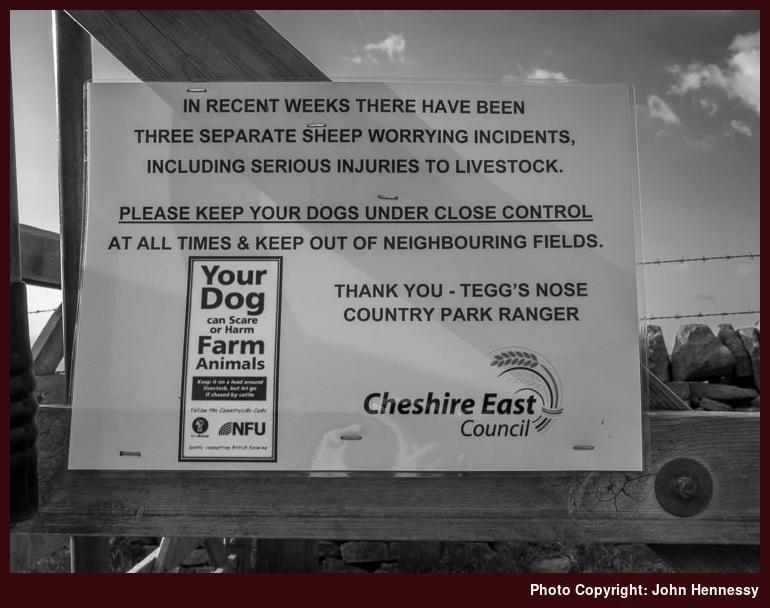
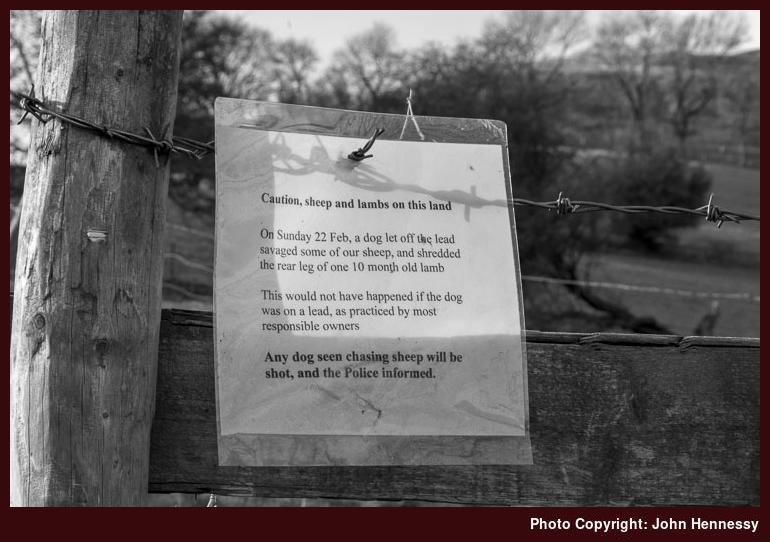
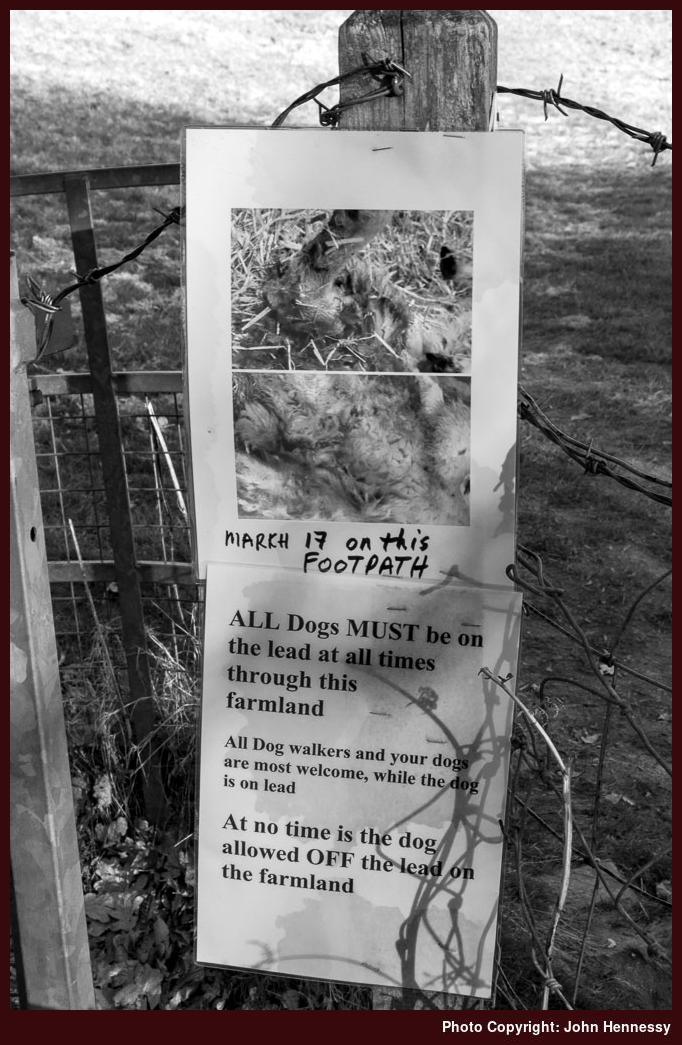
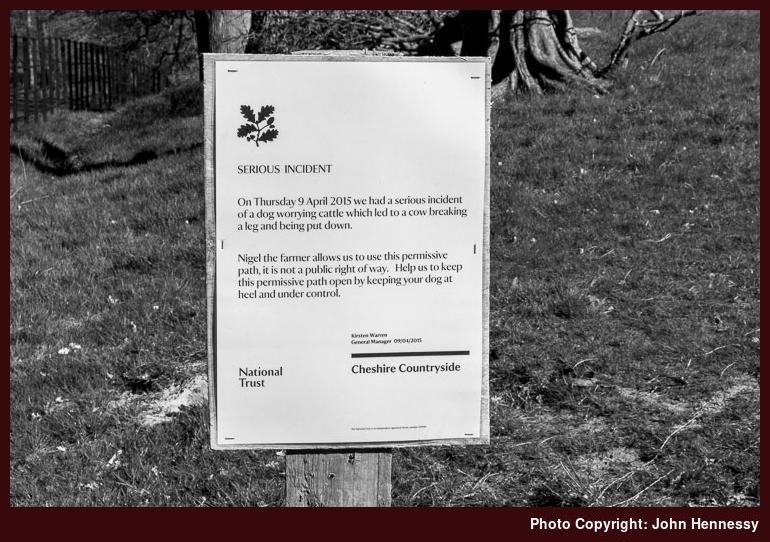
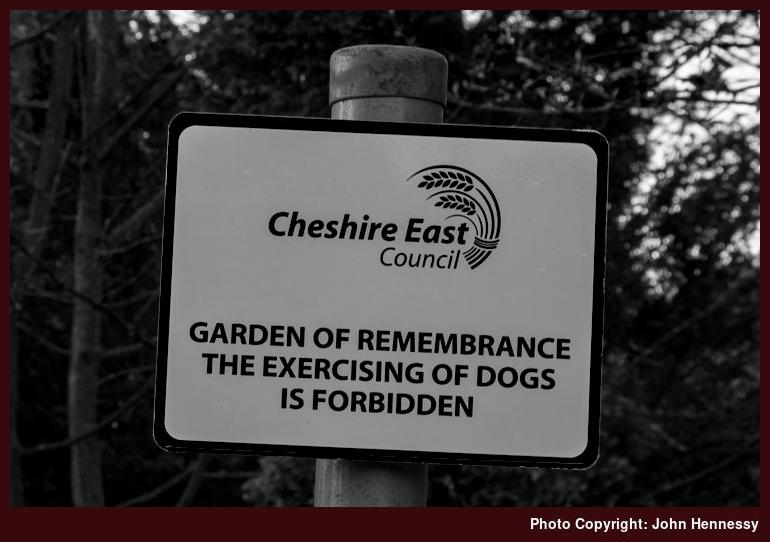
The first sign was seen on a visit to Tegg's Nose on Easter Sunday 2015 and remains there as I found on a more recent visit on a recent warm sunny Monday evening. Easter Monday 2015 saw me walk from Walker Barn back home via Macclesfield Forest, Shutlingsloe and Langley, which is where the second and third signs were encountered. The attack must have been so appalling that a shocking colour image was added to a poster; to protect the tinder of disposition, all of them are in black and white here. The fourth sign was met on a walk that took in Alderley Edge and Hare Hill, which proves that cattle are not immune from canine harassment. Subsequently, the permissive path was closed for the winter season and it is not hard to see why such a restriction came to pass. There has been criticism but it shows what a careless dog owner can cause us to lose in terms of goodwill. Even now, its opening is restricted to the hours from 10:00 to 17:00 between March 1st and October 30th and that highlights the need to always keep others in mind whatever we are doing, hardly a popular message in these individualistic times. Lastly, you would like that cemeteries and gardens of remembrance would be immune, but the above sign sadly is needed. Are we also losing awareness of our own mortality too?
Farm Dogs
It is all too easy to show disapproval of what others but we do have to look at ourselves too. While I never would own a dog myself now, I grew up on a farm where dogs were allowed to run loose. My first memories are of two Border Collies, an apparently placid mother and her son. However, there were some rumblings about his having had a go at someone walking on the road, so all may not have been as well as anyone would hope. Usually though, things were uneventful and they lived until an advanced age (for dogs anyway).
On a less friendly note, a lad working with my father on the farm had an enthusiasm for Alsatians and an intrusive one was kept in the farmyard for the sake of security. The creature did not last long though, since it was believed to have found either a poisoned rat or some rat poison. Up to that point, it had been a bit of a nuisance so it was not missed like the Border Collies that I think outlived it anyway.
After a few months without any dog in the place, there was something of a female puppy buying binge with three arriving one after the other. The first was another Alsatian, but this was nothing like its predecessor and showed the type of temperament for which many of the breed are known, albeit with perhaps less in the way of intelligence.
An Old English Sheepdog came afterwards and was anything but what my mother expected. She had wanted another placid Border Collie but instead got a lively hairy affectionate creature that was as daft as a brush and often wished to jump upon us, a right nuisance if we were dressed in better clothes.
Then, there was a cross-bred that was part Labrador Retriever and part Pyrenean Mountain Dog. Even though that one was the most sober of the lot, it still did not save my mother's washing from being pulled off the line from time to time. The tormenting cannot have made the lady enthusiastic about having any more young dogs about the place.
Sadly, both the Alsatian and the Old English Sheepdog met untimely ends. The latter was knocked over by a car on the road and rat poison or poisoned vermin was the suspected cause of death for the former. That left the Labrador cross-bred, so things were quieter, though my father, a light sleeper, got enough of all night barking sessions and puppies appeared from time to time too. It will make a dog lover wince to learn that all of these were destroyed and not always in the nicest manner either. After all this, the cross-bred eventually met her end and I seem to recall canine cancer being mentioned as a cause of death in the animal's older age.
After that, there was no replacement and I reckon that I am inclined to reckon that both of my parents were weary of having dogs by this point. Farm cats became substitutes though their begging at mealtimes grated enough to ensure a porch was added to the back of the house for the sake of extra peace. There also was a comical episode when my mother chucked a dustpan brush at cats to disperse them and my brother came the same way with a mate of his.
Reappraisal
Now that I look back on it, I am amazed by how freely those dogs were allowed to roam and how they largely were left to their own devices. Maybe it was when the three young dogs were about the place that it was realised quite what was involved in having them and the nuisance that could be caused. There might have been Barbara Woodhouse programs on the television along with One Man and his Dog, but the world outside the house was far less disciplined.
That is not to say that there were no rules for there was hardly any question of dogs being allowed into the house, though the pups were allowed in on their first night. That was the sum total of any such invasion. Even an attempted incursion during a thunderstorm was met with a rebuttal.
Since those times, my views have changed to agree with those of our local "DogFather", who writes in the Macclesfield Express and AlderleyEdge.com. Dogs need training and it was the lack of that that caused my parents so much intrusion. They also need continued discipline or they could be roaming the countryside causing havoc. It was not for nothing that there were ads on Irish television promoting the locking up of dogs by night to cut down on livestock worrying.
Another factor has been my being nipped in the ankles by dogs myself. The first was done by a Border Collie when I was returning home on my bike from a visit to my aunt and the light failing. More recently, a Jack Russell terrier did much the same while I was on a walk around Alderley Edge. After both incidents, I got my tetanus status checked and updated for very obvious reasons. They also colour my current view of dogs such that I give them a wider berth than during my days growing up in Ireland. That is not to say that I do not appreciate the need for dogs to be exercised and I also feel that those in charge of the creatures need to realise their responsibilities too. Not realising those will bring you the sort of nuisance that blighted my parent's lives and could affect wildlife, livestock and other people too. It is not for nothing that there is the slogan about a dog being for life and not just for Christmas.
Two visits to Llangollen
25th April 2016 It feels like a different world now that I look back on it but 2014 had its share of hill country excursions and these have yet to be recalled on here. All this came before my father's passing away near the start of 2015 and thoughts turned elsewhere afterwards. Naturally, there was grieving as I moved into an era with work to be done with my late father's estate. In fact, some of that remains outstanding yet and that still weighs on my mind a little as does the fact that neither of my parents are there any more.
More cheerful distractions have occupied my mind too, for I can begin to consider overseas explorations like those to Iceland and Switzerland last year. Associated mental meanderings still entertain me with recent explorations of the prospects of North American wilderness wandering still bringing their own learning episodes. While I am realistic about the chances of making those possibilities real, learning more about other parts of the world is good too.
One of the risks of doing this is that far-flung shores bedazzle me when similar delights are nearer to hand. In other words, they could have curtailed the motivation that once got me out and about the hill country of Britain and Ireland. Certainly, 2015 saw me doing less of such things and my main holiday breaks were spent overseas too. Still, you cannot journey among overseas mountains without doing so among home hills and I hope to rekindle those again.
A stormy winter has not helped that and the other topsy turviness of the past twelve months meant that I took to local cycling trips in a big way. That restored my cycling confidence after a break of around two years so I am not complaining. If it helps my going on cycling trips away from my home turf, it would be even better.
All remained ahead of me in 2014 and dared not to go foreseeing the future. There was enough on my plate with my keeping an eye on how my elderly father was doing back then. It was plain that he was not going to be there forever, so the focus was on what then was the present. It was a time when breaks were much needed so that got me out among hills on foot.
One might have thought that Christmas 2013 would have been tough going after the passing away of my mother earlier in the year but I was to find the one a year later much harder for a variety of reasons. My father must have got to thinking that Christmas 2014 was his last and it sure enough was. It may have meant that he had a dream for it that could not be made real, so that did not help. That a neighbour began to discuss plans for Christmas 2015 was no help either and became another obstacle to overcome, as if grief itself was not enough.
Maybe it is now that those are behind me that I can begin to write these words because every Christmas is becoming something to surmount with a breather afterwards. Forgetting the next one until it comes now is my way and it could have been that way for a while since I relished the peace of January and February even when my parents still were there.
After the ups and downs of early 2013, 2014 got a steady start and things were settling into a rhythm with my father though his fragile health meant that nursing home care was his lot even if never was one that he wanted. This semi-steadiness where a new set of circumstances had become familiar meant that my mind could to hill wandering and the middle of January 2014 saw a weekend visit to Llangollen.
2014-01-19
To make sure that I actually did make it to North Wales, I booked an overnight stay in Llangollen. It helped that it would not mean an early start on a Saturday to get there and I also broke any rut into which I had fallen by spending a night away from home. This was an uneventful stay too and the quiet of the dining room the next morning was a reminder of how early in the year it was.
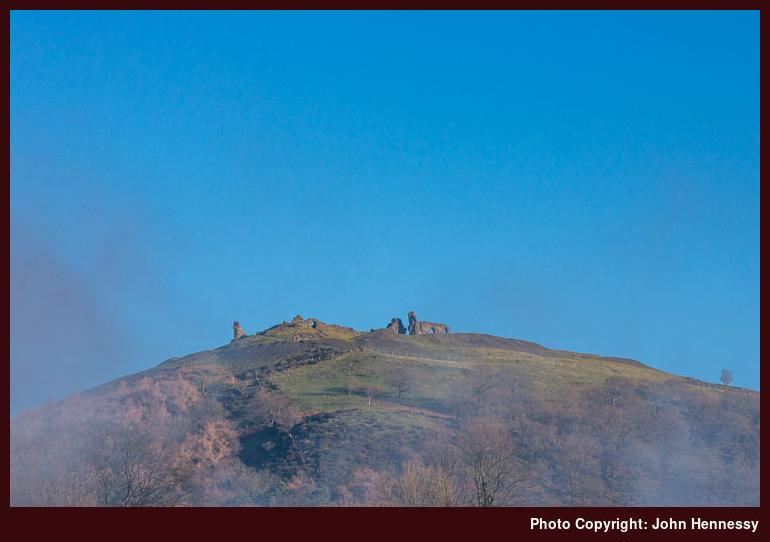
It was a frosty morning too as I dawdled around Llangollen. Though I had a day of walking ahead of me, it would have been rude to leave the place in haste with the sun out like it was. There was some clag about too and it circled the ruins of Castell Dinas Brân, but that was to burn off.
Soon enough, I found my way to the canal whose banks I was to follow out into the countryside. It also was the start of my shadowing the River Dee, a trend that was to follow for much of the day. That way out from Llangollen is familiar to me from many walks around there so it was a case of following the towpath, enjoying what lay about me and keep an eye on progress. Helping with the last of these were landmarks like the Royal International Pavilion and the train sheds of the Llangollen Railway.
The canal ends near the Horseshoe Falls, an attraction for many a stroller. Beyond this, I had a little bit of navigating to do, but a clear path was on hand to get me onto the road near Llantysilio's church, where I stayed a while to see if the sun would return from behind a cloud again to light it for a photo. It was not that willing so I got going again.
Road walking was my lot for a short while until I found the path that was to take me around by Llandynan. This was to take me through forestry where I was not so sure of where the path was. After some deliberation, I made my way out the other side to reach the collection of houses that I was seeking and where I was surprised by the course from there to Rhewl.
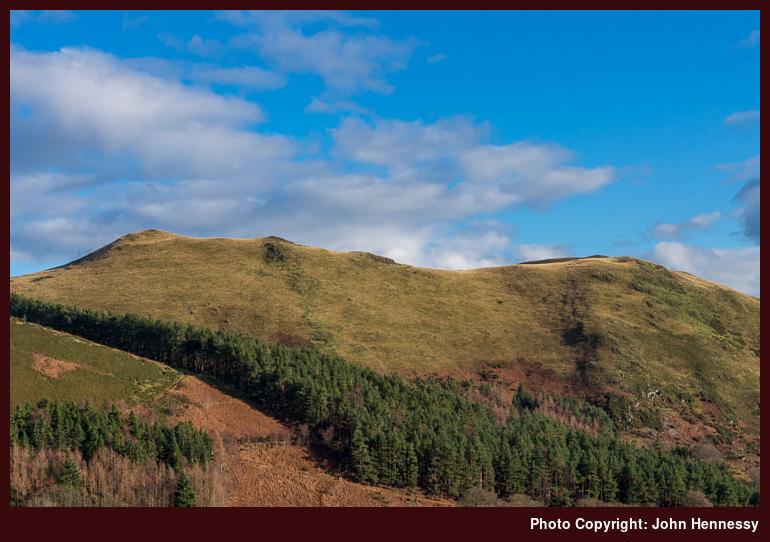
Rhewl too is a small place and I dallied there to make sure of where I was headed next. Once I was decided, the course was plain: follow a tarmacked byway uphill. This took me along part of the Clwydian Way and I found it steeper than anything I had met before that day, so stops were needed on the way. The scenery on view beyond the trees provided ample excuses, especially given that the sun was out again. One of those was where the road ended so I could take stock of what lay ahead of me. Though I thought them to be a series of rocky outcrops at the time, I also got to gaze at quarry spoil heaps that I was to pass later on.
On the other side of the gate, a gravel track awaited, and initial progress was across gentler gradients. Around the next corner, the way that the track was cut into the hillside became clear to me and it took an enticing line. Some height was lost so that had to be regained again on the way up to the pass between Moel y Gaer and Moel y Gamelin. With what surrounded me, it was a minor chore.
Once at the pass, I had a decision to make. Did I want to take in Moel Morfydd and Moel y Gaer before visiting Moel y Gamelin? Looking at the time, I made straight for the latter and it was to be the November visit when I trotted over the other two, not that I foresaw that at the time.
There is no right of way over Moel y Gamelin so it is just as well that this was access land and more folk were around there than elsewhere. Quite where they started was not clear to me, but the day's weather had drawn them just like me. There still was no crowding though and occasional friendly greetings accompanied the much-needed episodes of soothing solitude.
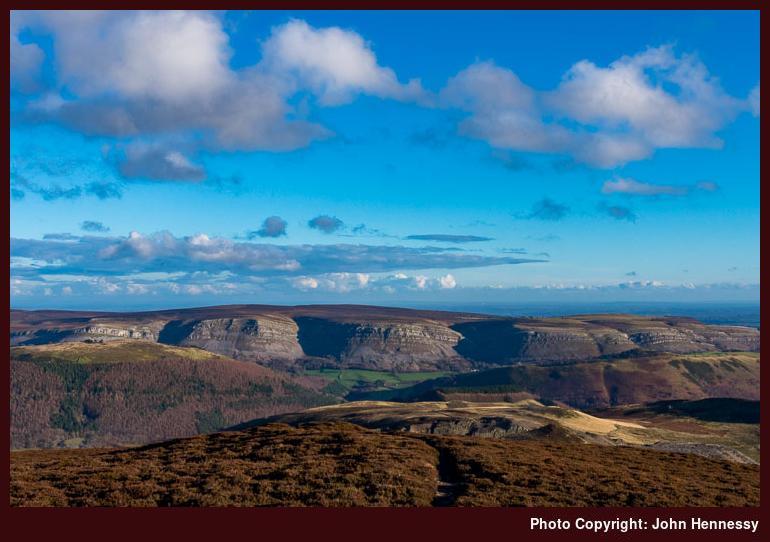
All the heat generated by the height gain resulted in the shedding of layers such that one might have thought that I'd thought it to be a spring day. There had been one last heave needed to get to the top of Moel y Gamelin and open up views over the Horseshoe Pass in all directions, including the distinctive Eglwyseg Mountain to the east. Though it was well into the afternoon, I was drawn as far as the top of neighbouring Moel y Faen before retracing my steps to pick up a public footpath that was to be the first leg of my return to Llangollen.
That hugged the steep hillside much like the Offa's Dyke Path crosses the aforementioned Eglwyseg Mountain. Along with the Horseshoe Pass below me, Berwyn Quarry came into view and acted as a reminded that I was in a working landscape. Later, I was to pass behind some of its spoil heaps before moving onto less industrial surroundings. There, paths looked less clear and I went around by Pen-y-Bryn because that was clearest and it usefully dropped me onto the Dee Valley Way near Llandynan so I could retrace my steps to Llangollen along the outbound route, a useful thing in declining light.
Travel arrangements:
Return train journey from Macclesfield to Wrexham. Bus service 5 from Wrexham to Llangollen and bus service 5A for the way back.
2014-11-22
Given the vagaries of the weekend weather forecast, I must have been in need of the getaway that took me to Llangollen on that Saturday before continuing to Barmouth the next day. The tale of the second part of the weekend has been moved to another post but it revisited places that I had not seen since 2005.
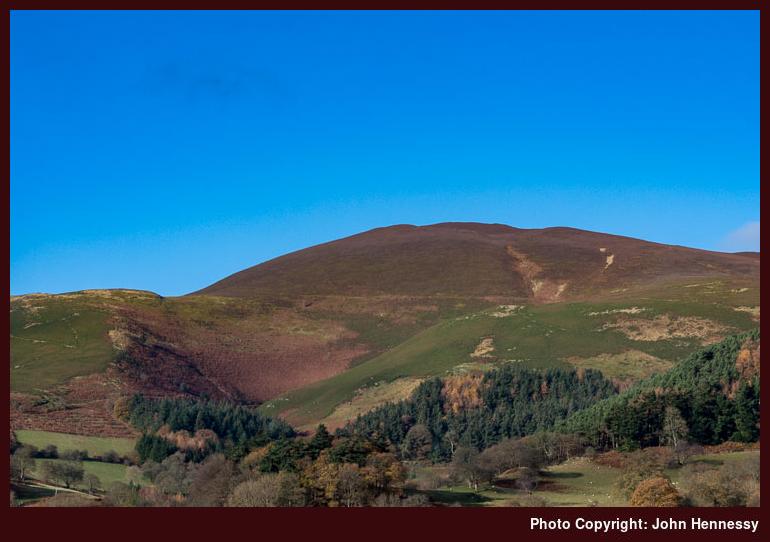
For the Llangollen portion of the escapade, I saw to unfinished business earlier in the year when Moel y Gamelin took my fancy. My hilltop objectives then became Moel y Gaer and Moel Morfydd and an early morning departure landed me in Llangollen. The initial stages of the walk even retraced much of the January route apart from sticking with the road as far as Rhewl because the wood near Llandynan did not inspire me when I was last there. The part of the Clwydian Way from there to the gap between Moel y Gamelin and Moel y Gaer was followed more faithfully. There seemed to be more pheasants than people for poor field-craft on my part was causing them to take flight in their usual noisy manner. The theme of unpeopled hills pervaded as good as the entire walk for whatever reason; it might have been the weather but that only can be a guess at best.
While I had started under sunny skies, clouds had staged a coup to show me why the weather predictions had been so variable. As I gained height to reach the top of Moel y Gaer, rain began to move in to dispel any hopes of much in the way of photos. Though it came and went, the wet theme continued until I was losing height again on the other side of Moel Morfydd when things dried up for me.
Then, the question came to the fore as to when to turn off the track I was following. This was not a right of way so it helped that I was on access land. Though the track would have taken me to a road that could have made for easier route finding, I decided that it would have gone the long way around and went so far along it for views before turning back to find a public footpath that would get me down part of the way. On open moorland, finding such things without signs takes a certain amount of deduction, so a navigational puzzle had been set. The further down I went, the more tricky it got until I finally got myself on the route of the Dee Valley Way as planned. From then on, route finding was more straightforward and became even more so after Rhewl when I merely retraced my steps, albeit in declining light. A night's rest was to follow before the rest of the weekend took shape.
Though I have yet to go back to see more of Llangollen's nearby hills, there are excuses for returning. Walking over Moel y Gaer and Moel Morfydd in better weather would be one and following the whole Dee Valley Way is another option. The latter would be a long day walk starting from Corwen and then continuing east as far as Llangollen. Then, there are those ups and downs of which I suspect it has many. It only goes to show that you never can say that an area is done, since there always is something new to see.
Travel arrangements:
Return train journey from Macclesfield to Wrexham. Bus service 5 from Wrexham to Llangollen and bus service X94 from there to Barmouth.
A few new photo albums
16th February 2016 After last year's overseas excursions, I finally got to internationalising the photo gallery. Photos from two visits to the Isle of Man are in their own album and ones from a business trip to Sweden are in another. My trip to Iceland last July yielded a bumper crop of photos as did that to Switzerland in September.
Stories of my Manx excursions already appear on here because I was following the coastal path around the west and south-west of the island. More urban sights are there to complement the in the gallery. There is not so much of the outdoors on view in the Swedish album since it was a business trip allowing evening walks around Södertälje and Stockholm. Also, I could have done with a better camera too but went without many hopes and with a life change in front of me. The tale of those wanderings is to be found in the travel section of the website so it has not been lost to online posterity.
In contrast, the Icelandic and Swiss escapades came after an even bigger life event. There are plenty of views of Icelandic countryside to go with those of Reykjavik even though the level of outdoor wanderings was not as extensive as those that have taken me around Britain. The Swiss outdoor incursions were more so thanks to the efficient public transport system that got me from Geneva to Zermatt and to Grindelwald, albeit at a cost. The sights that I got to see easily compensated for this though and I hope what is on view shows them at their best. Their stories has yet to be told in full on here and I already have the beginnings of those entries in place.
What I also hope is that more overseas explorations follow these. Norway, Germany and Austria are in mind and, out of curiosity, my mind has taken to explore the prospects of American, Canadian and Kiwi escapades. With what I have ahead of me already this year, I need to temper any soaring ambitions. Once outstanding personal matters are settled, only then can I really begin to dream about heading outside of Britain and Ireland again. In the meantime, the home countries still have a lot to offer me and parts of Ireland as yet unvisited by me may see my footfall. Reining in dreams can be good.
Thoughts on recalling distant memories
30th January 2016 Elsewhere on here, I went about recalling a trip to France from my schooldays and found out just how much had faded. Life's events have a habit of doing that to do as I have found over the past few years. Stress at work, worries about family and bereavement are all enough displace what went before and anything else that may have been going on at the time. It is just as well that I have an archive of photos for stirring my memories and some recent reading reminded me of this and how important it can be to look after those reminders.
Reading Patrick Leigh Fermor's accounts of his youthful excursion from Britain to Istanbul (or Constantinople as he called it) over the last few months amazed me with the powers of recall until the I came to last of the trilogy. This received posthumous publication following editing by Artemis Cooper (I too know what it is like to posthumous editing since I have website where my father’s writings on history are to be found and there is more to add to what already is there) and feels incomplete compared with what went before. In fact, it appears that Leigh Fermor often struggled with it only to have to stop due to the lack of inspiration. Those fruitless efforts must have led to the pained passages about the loss of diaries before the rediscovery of one got the whole narrative flowing again until it stops right in the middle of a sentence. Excerpts from contemporary diary entries bring matters to a close at Mount Athos in Greece with scarcely much said about the planned destination for his journey. It is not for nothing that the book got the name The Broken Road and, though initially disappointed by the lack of complete closure, I now reckon that the incomplete feel has more to say to me. That is not to say that the urge to do some editing of my did not seize me from time to time and I might have been tempted to get around what was blocking Leigh Fermor by adding in more of the times he spent in Romania and Greece afterwards with references to the last stages of the journey that took him to those places in the first place. It may not have finished things like a more conventional narrative but I could see something like that fitting together better.
The earlier books are more polished with the loss of a diary In Germany doing little to break up the narrative of A Time of Gifts, the first part of the journey that shadows the Rhine and the Danube before it stops on the Hungarian border. The same could be said of Between the Woods and the Water, which took up the story until the Iron Gates, and a rediscovery of a diary helped to to drive along nicely the writing of that. Hair-raising escapades litter the whole story and I suppose that meeting memorable characters helped ensure the survival of memories as much as retrieving a previously lost diary. Those escapades hint at a gregarious and inexperienced youth who charmed his way across Europe with his good company ensuring kindness along the way, a counterpoint to my own more cautious self. The observations of the cultures encountered along the way were as insightful as the descriptions of the histories that were learned from many a private library. As I was reading, I was being introduced both to a lost world and a part of Europe of which I scarcely knew very much at all.
It is twentieth century history that is to blame for that with the rise of communism creating an Iron Curtain across Europe that only fell in 1989 to make the 1990's a largely hopeful time in which to be living. Leigh Fermor was encountering the upheavals of history too on his journey. The aftermath of World War I was being felt from Austria eastwards. The Nazis too were on the ascendant at the time and Leigh Fermor after all passed through a Germany not long under Hitler's rule with news of the assassination of Austria's prime minister emerging later. Amazingly, these worrying developments did little to intrude on the good moments of the journey and became a contrast to what World War II was to do later on. The war and its aftermath took its toll on Leigh Fermor's situation since he lost access to diaries that he left in Romania while he returned to Britain to play his part. At times in his tale, he wonders what happened to the friends that he made on his crossing of Europe after the rise of communism and they already had lost much because of land reform before that.
Nevertheless, his being on foot for much of the journey caught my attention since that is my favoured means of exploration aside from cycling. The latter was never of a mode of travel for Leigh Fermor while episodes of travel in motor cars and on trains litter the narrative as well as on horseback across the plains of Hungary but it is those stretches where he is walking alone where the most acute observations were made. Rivers were followed and mountains encountered, much like my own wanderings, albeit in countries that I never have visited like the Netherlands, Germany, Austria, Czech, Slovakia Hungary, Romania, Bulgaria, Greece and Turkey. Even with my new-found taste for going beyond the shores of Britain and Ireland, some of these may continue to be surveyed from afar while others like Germany and Austria are on my wish list.


